Deal or No Deal Casino UK: Game and Play Guide
 Available in GB
The show’s case-by-case decisions are explained alongside checks on demos, bonuses, free spins and online play in Great Britain.
Table of Contents
- How the Deal or No Deal Game Show Builds to the Final Briefcase
- How Qualification, Top Up and the Main Game Fit Together
- Playing Online in Great Britain: What the UK Rules Require
- What You Can Establish About Demo and Free Play
- Bonus and Double Action Searches: What the Verified Information Shows
- Free Spins and Box Clever: Availability Is Not Verified
- What the 95.42% Return Figure Does—and Does Not—Tell You
- What a Review of Double Action or What’s in Your Box Could Verify
- Perfect Play: No Verified Variant Details to Assess
- Free Online Play: Confirm Availability Before You Assume It
How the Deal or No Deal Game Show Builds to the Final Briefcase
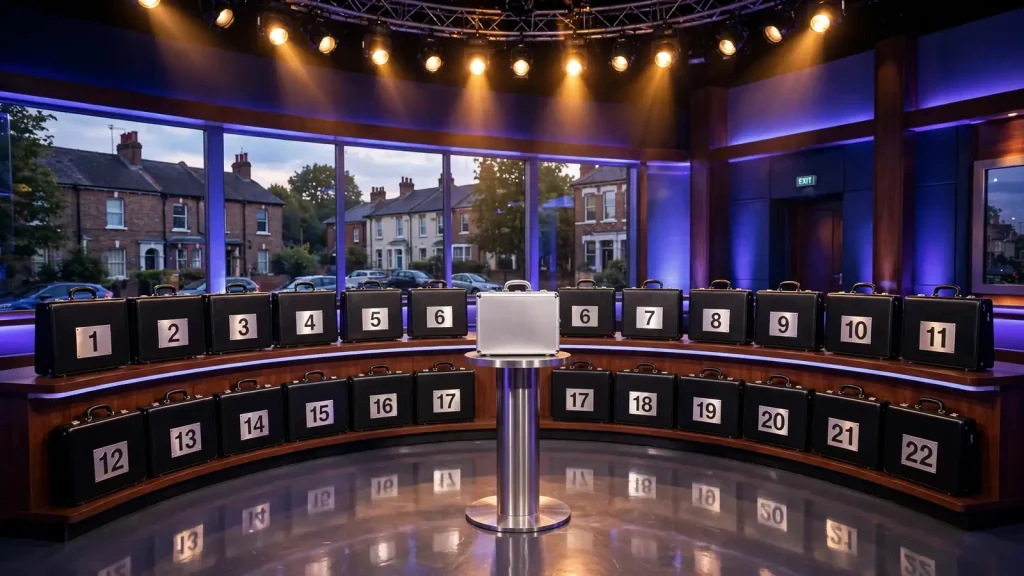
The televised format begins with a set of 16 briefcases. The central uncertainty is the amount of money contained in each one: contestants do not know which amount is associated with which case as the game unfolds. The tension comes from removing cases from play while deciding what to do when the Banker makes an offer. Each opening changes which briefcases remain, but it does not reveal the contents of the unopened cases.
In the first round, three briefcases are opened. The Banker then makes an offer, and the contestant must choose whether to accept it or carry on. The live host puts the choice into the show’s defining question: “Deal or No Deal?” This is a decision point, not just a slogan. Accepting means taking the Banker’s offer; declining means continuing with the cases still in play and facing the possibility of another offer later.
The opening round establishes the pattern that drives the broadcast: cases are opened, the Banker responds with an offer, and the contestant decides whether to stop or continue. The order matters. An offer arrives after the contents of selected cases have been revealed, so the contestant’s decision is made with some information about what has left the game and some uncertainty about what remains. The decision does not expose the contents of unopened cases. It determines whether the contestant accepts the offer or gives the game another stage.
Online Keno Casinos in the UK: Games and Odds · UK Casino Payouts: Fast Withdrawals and Keno Returns
The Banker makes three offers before the final stage. These offers create repeated decision points as the game progresses. At each one, the contestant can accept the amount offered or reject it and continue. If the contestant accepts, the game ends and they collect that offer. If they decline, the offer is no longer the outcome; play proceeds towards the later decision. That distinction is important: rejecting an offer does not lock in its value for the contestant.
The game’s structure is therefore a sequence of changing choices rather than a single decision at the end. After the first three cases are opened, the first offer gives the contestant an early opportunity to stop. Subsequent offers provide further opportunities to accept or continue. The format does not make the contestant’s decision for them. It places the offer alongside the remaining uncertainty, then leaves the choice with the contestant.
The final stage brings the remaining briefcases into focus. The contestant can accept the Banker’s offer, reject it and take the prize in their own briefcase, or switch to the last unopened briefcase. These are distinct outcomes. Accepting ends the game with the offered amount. Rejecting means the contestant keeps the prize attached to their own case. Switching changes which unopened case determines the prize. The final choice is not simply whether to take the offer: it can also involve choosing between the two remaining cases.
The show also frames the closing stretch around a prediction about the last briefcase to be opened. Contestants predict whether the amount of money in that case will be higher than the Banker’s offer. This gives the final decision a comparison point: the offered amount on one side and the amount associated with the last case on the other. The prediction concerns the relationship between those values; it does not itself reveal the case’s contents or settle which final option the contestant will choose.
In the televised format, the final choice can involve accepting the Banker’s offer, keeping the prize in your own briefcase, or switching to the last unopened briefcase.
Understanding the order of events helps distinguish the televised show from an online slot that borrows its name or presentation. In the show, the briefcases are opened in stages, offers come from the Banker, and a contestant responds to each offer by stopping or continuing. The final stage allows a choice between an offer, the contestant’s own case and the last unopened case. Those decisions make the format a sequence of linked choices, with the outcome dependent on where the contestant stops and which final option they select.
The title Deal or No Deal describes the repeated decision at the heart of the broadcast, but the final choice has more than two possible outcomes. Earlier in the game, accepting an offer ends play for that contestant. At the close, the contestant can also choose between briefcases rather than accept the offer. To follow the format, keep track of three things: which cases have been opened, whether an offer has been accepted, and which case or offer will determine the result. The remaining uncertainty is what gives each offer its context; the contestant’s decision determines whether the game continues or ends.
How Qualification, Top Up and the Main Game Fit Together
If you’re looking for a Deal or No Deal casino in the UK in 2026, payout speed is one practical detail to check. This list gives you a quick reference for the stated withdrawal times.
1. Amunbet
Payout speed: 1-3 business days Amunbet lists a payout speed of 1–3 business days, giving you a clear timeframe to consider.
2. NightWin
Payout speed: 1-3 business days NightWin lists a payout speed of 1–3 business days. You can use this stated timeframe as one factor when considering the operator.
3. SlotoSport
Payout speed: 1-3 business days SlotoSport lists payouts at 1–3 business days. That gives you a stated timeframe for withdrawals.
4. Britsino
Payout speed: 1-3 business days Britsino’s stated payout speed is 1–3 business days. You have a specific withdrawal timeframe to refer to.
5. EvoSpin
Payout speed: 1-3 business days EvoSpin lists a payout speed of 1–3 business days, a useful detail for you to check when weighing up your options.
6. x3bet
Payout speed: 1-3 business days x3bet states a payout speed of 1–3 business days. This gives you a clear reference point for withdrawals.
7. SpinFormula
Payout speed: 1-3 business days SpinFormula lists payouts at 1–3 business days, so you have a stated timeframe to bear in mind.
8. WinBeast
Payout speed: 1-3 business days WinBeast’s listed payout speed is 1–3 business days. You can factor this timeframe into your choice.
9. Dieselwin
Payout speed: 1-3 business days Dieselwin states a payout speed of 1–3 business days. It’s a concrete withdrawal detail for you to consider.
10. Jetsetspins
Payout speed: 1-3 business days Jetsetspins lists a payout speed of 1–3 business days, giving you a stated timeframe for withdrawals.
The game has a sequence: you qualify first, can then choose whether to use Top Up, and proceed to the Deal or No Deal game. Each stage has a distinct role. Qualification determines whether you enter the sequence; Top Up is an optional way to add to prizes before the main game; and the Banker’s offers become relevant once suitcases are being opened.
Qualification comes first
To qualify, all three rings must land on a gold slice. The condition applies to all three rings, not just one or two. If that condition is met, you move on to the next part of the game. Qualification is therefore a gate: it comes before the choice about Top Up and before the main Deal or No Deal game begins.
Keeping these stages separate makes the order easier to follow. The gold-slice condition is about entering the sequence. It is not the same decision as whether to use Top Up, and it is not an answer to a Banker offer. Those choices occur at different points.
Top Up is optional
After qualifying, you may use Top Up to add to prizes. The choice is optional: it sits between qualification and the main game, rather than replacing either one. If you do not use it, you can still proceed to the Deal or No Deal game. If you do use it, the added prizes form part of what is in play as the game continues.
Aviator Casino Game in the UK: Sites and Play · Live Dream Catcher Casino UK: How It Works
That distinction matters when following the sequence. Qualifying does not itself mean that Top Up has been used, and choosing Top Up does not end the process. The main game comes after these steps. Top Up is a choice to affect the prizes before that game, not the Banker’s later offer and not a way to accept or reject one.
The main game and the Banker’s offers
Once the main game is under way, suitcases are opened and the Banker makes offers as they are opened. The offer creates a decision point: you can accept it or continue. The offers occur during the game, so they are separate from the earlier qualification and Top Up stages.
Accepting any Banker offer ends that game. You collect the amount offered, and there is no further play in that game after acceptance. In practical terms, accepting converts the current offer into the outcome; it does not leave the game running so you can later change your mind or continue opening suitcases.
Rejecting an offer means continuing rather than collecting that offer. Further suitcases are opened, and the Banker may make another offer as play progresses. The choice is repeated when an offer is presented: take the amount offered and finish, or carry on with the game. Each decision affects whether that game ends at that point or continues.
Game Sequence
Step 1: Qualification
All three rings must land on a gold slice to enter the sequence.
Step 2: Top Up
Optional step where you can choose to add to the prizes before the main game starts.
Step 3: Main Game
Suitcases are opened and the Banker makes offers, providing decision points to accept or continue.
Step 4: Final Decision
After the fourth offer, you have the option to switch suitcases before the game concludes.
After the fourth offer, you can switch suitcases. This is a choice available at that stage of the sequence; it does not mean that accepting an offer keeps the game open. If you have accepted an offer, the game is already over. If you have continued, the switch option is relevant after the fourth offer, before play proceeds further.
The key is to track what kind of decision is in front of you. The gold-slice condition determines qualification. Top Up is an optional step that can add to prizes before the main game. Once suitcases are being opened, the Banker’s offers introduce a different choice: accepting ends the game and pays the offered amount, while continuing leaves the game in progress. Switching suitcases after the fourth offer is another decision within that later stage.
This order also clarifies what “playing the Deal or No Deal game” means in this sequence. It is not a single choice made at the start. First you meet the qualification condition; next you decide whether to use Top Up; then the main game proceeds through suitcase openings and Banker offers. The consequences depend on when you act: Top Up is chosen before the main game, while accepting an offer ends a game already in progress.
Playing Online in Great Britain: What the UK Rules Require
A Deal or No Deal-branded slot is still an online gambling product when you play it for money. Its theme does not change which rules apply to the casino offering it. In Great Britain, the UK Gambling Commission regulates commercial gambling, including remote gambling, and is the sole regulator for that activity. An operator offering remote gambling to consumers in Great Britain must hold the relevant Gambling Commission licence, even if its key equipment is located elsewhere.
Monopoly Live Casino UK: Format and Online Play · Live Roulette UK with English-Speaking Dealers
That distinction matters when a site presents itself as a UK casino. The physical location of its servers does not determine whether it needs a British licence. What matters is that it offers remote gambling to consumers in Great Britain. The Gambling Commission issues operating licences to gambling businesses and personal licences to individuals who perform specified roles in the industry. A business licence is the key authorisation to check when you are deciding whether a casino is licensed to serve this market.
Check the operator, not just the game title
A title or game image cannot establish that the casino offering it is authorised. Before you deposit, find the operator’s licence details on its website and compare them with the Gambling Commission’s public register. Check that the licence belongs to the business actually operating the casino, rather than relying on a logo, a claim in an advertisement or a licence belonging to another company in the same group.
The register gives you a way to verify the operator’s regulatory status independently. UK-licensed remote operators must also display their licence information on the gambling websites and apps they provide and link to their register entry. If the details are absent, do not treat a familiar brand name or a Deal or No Deal slot listing as a substitute for checking. If the licence information does not match the business you are dealing with, pause before creating an account or sending money.
License Verification
Do not treat a familiar brand name or a game listing as a substitute for verifying that the operator holds a valid Gambling Commission licence on the public register.
A search result or page calling itself an online casino does not establish that the operator holds a British licence. The same is true of a site offering several Deal or No Deal slots online: the number of titles it lists has no bearing on whether the business is authorised. The relevant question is whether the operator serving you has the required licence for Great Britain.
What licensing means for your account
A UK-licensed casino must verify your age before allowing you to deposit funds. Online gambling is legal in the UK for adults aged 18 and over when it takes place through an operator holding a UK Gambling Commission licence. Age verification is therefore not just an optional account feature; it is part of the operator’s obligations.
Licensed operators must also provide account-level controls, including financial limits, and prompt new customers to set a financial limit before their first deposit. They must offer responsible gambling tools such as self-exclusion. These requirements apply at the account and operator level, not because a particular Deal or No Deal casino slot has a special regulatory status.
Live Baccarat Online Casino UK: Rules and Tables · Live Casino Lightning Roulette UK: How It Works
There are also rules about how online slots can be played and funded. In Great Britain, autoplay is not permitted for online slots, and at least 2.5 seconds must pass from the start of one game cycle before another can begin. The maximum stake for an individual slot game cycle is £2 for customers aged 18 to 24 and £5 for customers aged 25 or over. Licensed operators cannot accept credit-card payments for gambling, including credit-card funds routed through a money service business. They also cannot accept wallet payments where the wallet allows credit-card funds to be used for gambling.
These are general requirements for licensed online gambling, not claims about the particular controls or design of a named game. Whether a listing is described as a Deal or No Deal slot machine, an online casino game or a Slingo title does not remove the operator’s duty to follow the rules that apply to its product and service.
If something goes wrong
A UKGC-licensed casino must provide an internal complaints process and access to an approved Alternative Dispute Resolution service. If you have a dispute, start by following the operator’s stated complaints procedure and keep relevant messages and account records. The operator should explain how to raise the issue and how to access its dispute-resolution route.
Checking the licence before depositing helps you establish which regulatory framework applies to the operator. It does not guarantee a particular outcome in a game or resolve every disagreement automatically. It does let you confirm whether the business is authorised to offer remote gambling to consumers in Great Britain and whether the obligations described above apply to it.
Do
- Verify the operator’s licence via the Gambling Commission’s public register
- Use account-level financial limits and self-exclusion tools
- Follow the operator’s internal complaints process for disputes
Don’t
- Rely on a logo or advertisement to confirm regulatory status
- Use credit cards or certain wallet payments for gambling
- Use autoplay when playing online slots
What You Can Establish About Demo and Free Play
A Deal or No Deal slot demo and a free-play version are not the same thing as a description of how the game works. Knowing the rules of a game does not tell you whether a casino or game provider makes it available to play without staking money. Availability has to be confirmed for the specific title and the place where you intend to play.
The same distinction applies when you encounter a Deal or No Deal slot described as free. That wording might refer to a playable mode, a promotion, or simply a page discussing the game; the phrase alone does not establish which. Do not treat a title, search result or game description as proof that you can open the game and play it for free.
A demo, if one is offered, is a separate access option from real-money play. Those details depend on the specific product and its provider.
This matters when a game is labelled with an additional name or format. A reference to a Deal or No Deal Megaways slot does not, by itself, verify that a particular Megaways title exists or that it has a demo. Nor does the label establish the game’s features. Check the exact title shown by the operator and look for a clearly identified demo or free-play option on that game’s own page. If no such option is displayed, do not assume it is available because another page uses similar wording.
Casino Dice Game UK: Rules, Formats and Licensing
Keep the scope of any free-play claim narrow. Confirmation that one title can be tried without a cash stake would not prove that every Deal or No Deal slot has the same option. Equally, a game being listed at a casino does not establish that it can be played there in demo mode. The title, provider and access option need to refer to the same game.
If you cannot find an explicit free-play or demo control attached to the exact title, the practical answer is that availability has not been established. You can ask the casino or provider to confirm it, rather than relying on a general description. Do not infer terms such as account requirements, play limits or conversion to real-money play; those would need separate confirmation.
For a Megaways-labelled game, apply the same test: verify the exact product and whether its page offers a non-cash mode. The wording of a listing is not enough to establish either point. This keeps the distinction clear between a game’s identity, the way it is described and the access options actually provided.
The same limit applies to free play and to Megaways-labelled titles. Treat availability as unconfirmed unless the exact game page or its operator clearly says otherwise.
Bonus and Double Action Searches: What the Verified Information Shows
A no-deposit bonus and a Deal or No Deal game title are separate things. The phrase “no-deposit bonus” describes a promotion someone may be looking for; it does not establish that a particular casino offers one, or what its terms are. A game’s name, meanwhile, does not tell you whether a promotion applies to it. Treating the two as one offer can lead you to assume a bonus is available when the game title alone gives no basis for that conclusion.
Attention A game title alone does not confirm the availability of a no-deposit bonus or specific bonus round features; always check the operator’s promotion terms separately.
The same distinction matters when a title includes Double Action or Golden Box Megaways. Those names may appear in a listing or in an account of a game, but a name by itself does not explain the rules, features or conditions of play. Do not infer that either title has a particular bonus round, format or relationship to another Deal or No Deal game unless the operator’s game information confirms it.
In the bonus game, the Banker makes offers as briefcases are opened, and the player may accept an offer or carry on. There are four offers before the final stage; after the fourth, the player can switch the two remaining briefcases before they are opened. These details describe that game sequence.
This distinction also helps when assessing a casino promotion. A bonus claim concerns the offer made by the casino, while a game description concerns what happens during play. Neither should be used as proof of the other. If a page advertises a no-deposit bonus alongside a Deal or No Deal title, check the promotion’s own wording and the game’s own information separately. The title cannot confirm eligibility, and the existence of a game description cannot confirm a bonus.
For Double Action, Golden Box Megaways and no-deposit offers, rely on information that identifies the specific product or promotion and explains its terms. Avoid carrying rules from the documented Banker-offer game over to a differently named title.
Live Blackjack Online Casino UK: Rules and Tables
Free Spins and Box Clever: Availability Is Not Verified
A mention of free spins alongside Deal or No Deal does not, by itself, tell you whether spins are offered for a particular game. It may refer to a promotion, a search for a way to try a game, or wording on a page; those are not interchangeable. Treat free spins as a separate offer unless the relevant operator’s own terms clearly connect them to the specific game.
Before relying on an offer, check its current terms on the operator’s site. The terms should identify which games qualify and explain any conditions attached to using the spins or receiving winnings. Do not assume that a general casino promotion applies to a Deal or No Deal title, or that a mention of free spins means they can be used without making a deposit. Those details depend on the actual offer, not on the game’s name.
Box Clever is a separate point: the name alone does not establish what the game contains, who provides it, or whether it is available to play. A listing, search result or promotional description can help identify what is being referred to, but it is not a substitute for the game information shown by the operator. Check that the displayed title matches the product you intend to open; similar wording does not prove that two listings describe the same game.
Keep the two questions distinct. Whether a Box Clever title is offered is a question about a named game. Whether free spins can be used on it is a question about a particular promotion and its eligible games. An answer to one does not settle the other. If you cannot find the title in the operator’s game catalogue, or the offer’s terms do not name it, do not assume either availability or eligibility.
Whether a Box Clever title is available and whether free spins can be used on it are two distinct questions; eligibility for one does not guarantee the other.
What the 95.42% Return Figure Does—and Does Not—Tell You
A specialist affiliate review reports that the game help files give an expected return of 95.42%. This is a figure attributed to those help files, not a confirmed return rate for every Deal or No Deal-branded slot, and not specifically for the What’s in Your Box title.
An expected return is a theoretical measure of how a game is designed to pay back stakes across play. It is not a prediction of what you will receive in a particular session. Individual results can differ, and the figure does not tell you whether a short run will finish ahead or behind. Nor does it establish that the same calculation applies to another game that shares the Deal or No Deal name.
That distinction matters when you are assessing the return for What’s in Your Box. The reported percentage alone does not identify the game version to which it applies, confirm that this variant uses the same settings, or describe its features. It also cannot establish whether a particular review’s verdict on the variant is justified. Those points require information tied directly to that game, rather than an expectation figure associated with game help files.
Treat 95.42% as a reported specification with a narrow scope. It is useful only when the relevant game and its help information are clearly identified. If you cannot match the figure to the exact title you intend to play, you cannot safely use it as that title’s RTP. A shared brand name is not enough to establish shared mathematics.
French Roulette Online Casinos in the UK: Rules & Play
The figure therefore answers one limited question: what expected return the cited help-file information reports. It does not settle the return, performance or quality of the What’s in Your Box slot. Keep those claims separate, and do not read a general figure as a variant-specific guarantee or review conclusion.
What a Review of Double Action or What’s in Your Box Could Verify
A review of Deal or No Deal Double Action or What’s in Your Box should identify the exact game being assessed before describing its features. A shared title does not establish that two slots use the same rules, presentation or outcomes. The name alone is not enough to predict how a particular version plays.
For either title, a useful review would explain the game’s sequence: what starts a round, what choices are available, and how a result is decided. It would also distinguish any bonus feature from the base game and state the conditions that trigger it. If a feature changes the player’s choices or the way prizes are determined, the review should describe that change precisely rather than relying on a label such as “Double Action” or “What’s in Your Box”.
Performance claims need equally specific support. A review should state which version and configuration its figures refer to, explain what the reported measure means, and avoid applying a result from one game to another. A general return figure for a Deal or No Deal game does not, by itself, establish the return or performance of either named variant.
Reviewing Slots
- Ensure the review identifies the exact game version being assessed
- Distinguish between the base game and specific bonus features
- Verify that performance figures (like RTP) are tied to the specific title
- Confirm that practical details like device behavior are documented rather than inferred
The same checks apply to practical details: whether the game is available through the operator being reviewed, how it behaves on the device being tested, and whether its displayed rules match the account of its features. These are observations a review would need to document, not properties that can be inferred from the title.
Treat a review as an assessment of a specific, identifiable game, not as proof that every slot carrying the Deal or No Deal name behaves alike. Without clear identification and evidence for the stated rules and figures, conclusions about Double Action or What’s in Your Box would go beyond what the title alone can support.
Perfect Play: No Verified Variant Details to Assess
The name Perfect Play does not, by itself, explain how a Deal or No Deal slot works. It is not enough to infer the rules, prize structure, special features or expected return. Those properties belong to the particular game, not automatically to every title associated with the television format.
If you are assessing a game presented as Perfect Play, start with its own title screen and help file. Check the stated rules for how a round begins, what actions are available and how the outcome is determined. Then compare those instructions with the controls and symbols shown during play. A feature should be treated as part of the game only when its instructions describe what it does and when it can occur.
Keep numerical claims separate from the game’s name. A return percentage, for instance, needs to be tied to the specific title and its published game information; a figure associated with another Deal or No Deal game cannot establish the return for Perfect Play. The same principle applies to volatility, prize values and any claim about how often a feature appears. Without title-specific documentation, those are not properties you can reliably assign.
Fastest payout online casino UK: what evidence shows
The distinction matters because shared branding can make different games appear interchangeable when their mechanics may not be. A review of Perfect Play would need to identify the exact title and support each claim with its own rules or other reliable documentation. Until those details are established, the practical point is simple: do not use the Perfect Play name as evidence of a particular feature or performance. The title identifies what to investigate; it does not tell you what the game does.
Free Online Play: Confirm Availability Before You Assume It
A description of how a Deal or No Deal game works does not establish that you can play it online without paying. The rules of a game and the terms on which a website makes it available are separate matters. Knowing the game’s sequence, for instance, cannot tell you whether a free-play option exists.
Treat claims about free online access as something to check for the specific game and website you have in mind. Look for an explicit statement that the game can be started without a deposit or a real-money stake. A game page, title or promotional image alone does not confirm that access is free; nor does the presence of a play button explain whether it leads to a free mode or a paid game.
Check what the site says before creating an account or making a payment. If the wording is unclear, ask the operator to confirm whether the particular game can be played for free and what, if anything, is required to access it. Do not infer free availability from the fact that a game has familiar rules or from a general reference to online play.
This is a narrower question than whether a particular demo, free-spin offer or named variant exists. Each would need its own confirmation. For the broad question of playing Deal or No Deal slots online for free, availability cannot be assumed: the information about the game’s mechanics does not confirm that such an option is offered.
Casino Games

Aviator Casino Game in the UK: Sites and Play
A practical guide to UK licensing, play modes, casino checks, bonus conditions, crypto payments and...

3-Reel Slots in the UK: Browser Play Explained
Three-reel games use software to apply each spin’s rules, while the browser displays the reels,...

5-Reel Slots in the UK: Demos, Layouts and Play
Five-reel games share a layout of five vertical reels, while their features, volatility and ways...

Bonus Buy Slots UK: Features, Rules and Play
A practical guide to bonus-feature costs, demo mode, slot volatility, Great Britain stake rules and...

UK Casino Payouts: Fast Withdrawals and Keno Returns
Learn how keno’s expected return differs from individual results and what information is needed to...

UK First-Deposit Casino Bonuses: How Offers Work
First-deposit offers can differ in how rewards are credited and used, so the terms define...

High-Volatility Slots in the UK: Bet and Payout Guide
A practical guide to reel-wide bets, payout patterns, RTP limits and the session choices that...

Online Keno Casinos in the UK: Games and Odds
Online keno uses an RNG to draw numbers from a card numbered 1 to 80,...

Live Casino UK: How Games, Rules and Bonuses Work
Live casino combines a dealer's video feed with controls for betting and decisions, while rules...

Best Low-Volatility Slots in the UK: What to Know
See how payout frequency, win size and RTP contribute to a slot’s overall pattern, and...

Online Slot Payout Percentage: How RTP Works
RTP describes a game's theoretical long-run return, while individual spins and sessions can produce very...

Best RTP Casino Slots in the UK: How Returns Work
RTP describes a theoretical long-run return, not a promised payout or guide to when wins...

Video Slots in the UK: Stakes, Features and Free Play
A practical guide to reel outcomes, stake displays, bonus features, browser play and checks to...

Casino Dice Game UK: Rules, Formats and Licensing
Explore dice-game mechanics, demo limits, Bitcoin options and the licensing checks relevant to online casino...

Chicken Road Game in UK Casinos: How It Works
The guide distinguishes stake-based outcomes from branding and explains why the title alone cannot confirm...

Crash casino games in the UK: rules and checks
Crash is a format label, not a standard rule set; availability, payment options, demos and...

Crazy Time Live Casino Game in the UK
A practical guide to the live stream, betting controls, casino-site checks and the limits of...

Fastest payout online casino UK: what evidence shows
A look at what payout-speed evidence can show and how keno draws, matches and paytables...

French Roulette Online Casinos in the UK: Rules & Play
French roulette’s zero rules can change the cost of an even-money bet, while table formats,...

Hi-Lo Casino UK: Rules, Strategies and Site Checks
Learn how higher, lower and matching-card rules shape a round, and what to compare across...

High-RTP Slots in the UK: How Returns Work
RTP describes a game's theoretical return across repeated play, while individual outcomes can vary from...

JetX casino game in the UK: labels and access
A game’s name or listing does not establish its mechanics, category, demo options or availability...

Live Baccarat Online Casino UK: Rules and Tables
Follow the hand from the opening deal to the final comparison, then weigh table formats,...

Live Blackjack Online Casino UK: Rules and Tables
A practical guide to UK licensing checks, table rules, stakes, live formats and how decisions...

Live Casino Lightning Roulette UK: How It Works
A practical guide to the live studio, betting interface, roulette wheel types and the limits...

Live Dream Catcher Casino UK: How It Works
Live dealer play pairs a real-time studio stream with on-screen betting, while table pace and...

Live Roulette UK with English-Speaking Dealers
Live roulette pairs a dealer and physical wheel with an online betting interface, while rules...

Mines Casino Game in the UK: Rules and Risks
A clear look at how game rules, random outcomes, demos and simulator results shape what...

Monopoly Live Casino UK: Format and Online Play
Monopoly Live combines a real-time dealer stream with digital betting controls, so the stream and...

Online Bingo in the UK: Formats, Slots and Play
See how ticket layouts and winning patterns shape bingo play, and how slot games, offers...

American Roulette Online Casinos in the UK: Rules & Odds
Learn how the double-zero wheel differs, how bets and payouts work, and what to check...

European Roulette at UK Online Casinos: Rules & Bets
A practical guide to the single-zero wheel, table bets, payouts, free and real-money play, and...

Online Casino Games for Real Cash in the UK
A practical guide to slot mechanics, real-cash offers, bonus conditions and the rules and payout...

Online Casino Tournaments UK: Formats and Scoring
Slot tournaments can use single or elimination rounds, with rules governing scores, entry, prizes and...

Online casino without ID in the UK: what to expect
UK rules require casinos to check eligibility, so claims of permanent access without identity checks...

Plinko Casino UK: Games, Real Money and Regulation
A guide to assessing Plinko availability, UK casino status and the conditions attached to play....