Non-UK-Registered Casinos: Regulation Explained
 Available in GB

A guide to UKGC oversight, offshore licensing, self-exclusion, payments and checks that help assess an operator.
Table of Contents
- What “Non-UK-Regulated” Means
- What UK Law Says About Using Offshore Gambling Services
- How GamStop Exclusion Relates to Non-UK Casinos
- How Offshore Casino Payments, Bonuses and Withdrawals Work
- What to Check Before Trusting an Offshore Casino
- Gamban and Casinos Outside UK Self-Exclusion
- How a UKGC-Licensed Casino Differs
- What Anjouan Licensing Does—and Does Not—Verify
- What a Malta Casino Licence Tells You
- Curaçao Casinos Outside GamStop: What the Licence Context Establishes
What “Non-UK-Regulated” Means
A non-UK-regulated casino is an online gambling site that operates without oversight from the UK Gambling Commission (UKGC). The term describes the regulator that does not oversee the site; it does not, by itself, tell you where the operator is based or whether another authority licenses it.
This distinction matters because “non-UK registered” is often used as shorthand for “not regulated by the UKGC”. Registration and regulation are not the same thing: a business may be incorporated or based in one place, while its gambling activity is licensed in another. To understand a site’s status, separate three questions: which authority oversees its gambling operation, which jurisdiction issued its licence, and where the operator is located. The first two concern regulation; the third concerns location.
A site without UKGC oversight is not necessarily unregulated everywhere. Non-UK-regulated casinos are typically licensed in jurisdictions such as Malta, Curaçao, Gibraltar or Anjouan. In that case, the relevant authority is associated with the jurisdiction named on the licence, rather than the UKGC. The presence of a foreign licence therefore changes which regulator is involved; it does not make the licence a UKGC licence.
If you’re considering casinos not registered in the UK, payout timing is one practical detail to check before choosing where to play. Use this list as a starting point and review each casino’s terms and suitability for you.
1. Amunbet
Payout speed: 1-3 business days Amunbet is listed with a payout speed of 1–3 business days, giving you a stated timeframe to consider.
2. NightWin
Payout speed: 1-3 business days NightWin’s listed payout speed is 1–3 business days, a useful detail for you to weigh when considering it.
3. SlotoSport
Payout speed: 1-3 business days SlotoSport has a stated payout speed of 1–3 business days, so you have a timeframe to factor into your decision.
4. Britsino
Payout speed: 1-3 business days Britsino is listed with payouts taking 1–3 business days, which gives you a clear timing detail to review.
5. EvoSpin
Payout speed: 1-3 business days EvoSpin’s listed payout speed is 1–3 business days, a practical point for you to consider.
6. x3bet
Payout speed: 1-3 business days x3bet is listed with a payout speed of 1–3 business days, giving you a stated expectation for payment timing.
7. SpinFormula
Payout speed: 1-3 business days SpinFormula has a listed payout speed of 1–3 business days, which you can take into account when assessing it.
8. WinBeast
Payout speed: 1-3 business days WinBeast’s stated payout speed is 1–3 business days, a useful timing detail for you to check against its terms.
9. Dieselwin
Payout speed: 1-3 business days Dieselwin is listed with payouts taking 1–3 business days, giving you a stated timeframe to consider.
10. Jetsetspins
Payout speed: 1-3 business days Jetsetspins has a listed payout speed of 1–3 business days, a practical detail for you to review before deciding.
Nor does the licence jurisdiction necessarily identify the operator’s physical base. A casino may present a licence issued in one jurisdiction while the company behind it is located elsewhere. The name of a jurisdiction on a website is therefore a clue about the claimed licensing framework, not a complete description of where the business operates. “Non-UK-based” and “non-UK-regulated” overlap in some cases, but they are not interchangeable labels.
The word “licensed” also needs to be read precisely. It refers to authorisation associated with a particular regulator and jurisdiction. It does not mean that every casino holding a licence from that place is overseen in the same way, or that the licence carries the same scope as one issued elsewhere. Malta, Curaçao, Gibraltar and Anjouan are separate licensing jurisdictions. Their names should not be treated as alternative spellings for a single international standard.
This is why a search for online casinos not registered in the UK can lead to sites with different regulatory arrangements. Some may identify Malta as their licensing jurisdiction; others may name Curaçao, Gibraltar or Anjouan. Those names tell you that the claimed oversight is outside the UKGC system. They do not, on their own, establish that the sites have identical permissions or operate under equivalent rules. A licence needs to be understood in the context of the authority that issued it.
The distinction also prevents a common category error: “not regulated by the UKGC” does not automatically mean “not regulated by any authority”. A casino may be outside UKGC oversight and still claim a licence elsewhere. Conversely, the existence of a foreign licence does not make the casino UKGC-regulated. The regulator’s identity, rather than the casino’s language, branding or apparent location, determines which category the phrase describes.
Terms such as “online casino not registered with GamStop” refer to a different question from the casino’s licensing jurisdiction. GamStop is a UK self-exclusion scheme, while “non-UK-regulated” describes the absence of UKGC oversight. A casino’s jurisdictional label does not by itself establish its status in relation to that scheme. These terms may appear together in descriptions of the same site, but they do not mean the same thing.
Non-GamStop European Casinos: UK Exclusion Explained
Likewise, describing a site as a Curaçao casino identifies a claimed licensing connection; it does not, by itself, settle whether that casino is outside GamStop or where its operator is based. The same care applies to Malta, Gibraltar and Anjouan. Each name points to a distinct jurisdiction, and the label should not be stretched beyond that basic information.
When you encounter “non-UK-regulated casino”, read it as a statement about oversight: the UK Gambling Commission is not the authority supervising that online gambling site. Then consider any separate claims about its licence and the operator’s location as separate facts. This keeps the terminology clear without assuming that a foreign licence is equivalent to UKGC oversight or that every site using one of these jurisdiction names has the same regulatory position.
What UK Law Says About Using Offshore Gambling Services
The legal position depends on whose conduct you are considering. The rules governing a gambling operator that supplies services to the British market are not the same as the rules applying to an individual who places a bet. Treating those questions as one can make the status of a non-UK registered casino seem simpler than it is.
The Gambling Act 2005 is directed at operators providing gambling services into the UK market. A company cannot avoid that framework simply by locating its business abroad: offering services to customers in Great Britain requires the relevant UK Gambling Commission licence. This requirement concerns the operator’s permission to serve that market. A licence issued by another country does not replace it.
That does not mean the same Act makes a player’s use of an unlicensed site a criminal offence. Under UK law, an individual who gambles on a site without a UK licence is not committing a criminal offence merely by doing so. The distinction is between an operator’s regulatory obligations and a player’s criminal liability; the absence of a player offence does not grant the operator permission to supply services in Britain.
Online Casino No Registration UK: How Checks Work
Nor does UK law expressly bar British citizens from using gambling services that hold a licence in another country. That point should be read narrowly. It describes the position of the individual player, not whether the overseas operator is authorised to target or serve customers in Great Britain. A casino may have permission from its own jurisdiction while still lacking the UKGC authorisation required for the British market.
For that reason, “not prohibited for the player” and “legally authorised to serve UK customers” are not interchangeable conclusions. The first concerns whether the individual faces a criminal offence for gambling on an unlicensed site. The second concerns the operator’s compliance with the rules for supplying gambling services to Great Britain. The operator’s location, or the existence of a foreign licence, does not settle that second question.
You may therefore encounter non-UK registered casinos that accept British customers, but their availability should not be mistaken for UK regulatory approval. The legal test for an operator is tied to the market it serves, not simply to where it is incorporated or where its licence was issued. At the same time, the stated position for players is that gambling on an unlicensed site does not itself amount to a criminal offence under UK law.
This distinction is useful when reading claims about casinos not registered on GamStop or about overseas licences: those labels do not answer the separate question of an operator’s UK authorisation. The relevant legal questions are who is providing the gambling service, which market it is serving, and whether it holds the licence required for that activity. The player’s liability question must be kept separate from those operator obligations.
How GamStop Exclusion Relates to Non-UK Casinos
GamStop is the UK Gambling Commission’s self-exclusion scheme. Casinos outside that scheme do not receive or apply a GamStop exclusion. If you register with GamStop and then try to open or use an account at a non-UK-regulated casino, you should not assume the exclusion will stop you there. The key distinction is whether the operator is part of the UK scheme, not whether its website is accessible from the UK or describes itself as reputable.
Self-Exclusion Risk
If you rely on GamStop to prevent gambling, be aware that these barriers are not present at non-UK-regulated casinos.
A GamStop registration is intended to prevent access to gambling accounts with participating operators. It is not a technical block on every gambling website, and it does not automatically carry over to a casino operating beyond the UKGC system. As a result, “casino not registered with GamStop” describes a limit of the scheme: the operator is outside its network, so the exclusion does not bind that casino through GamStop.
This matters if you chose self-exclusion because you wanted a barrier between yourself and gambling. At a site outside GamStop, that barrier may not be present. You could encounter a registration process that does not check your GamStop status, and your exclusion would not itself require the operator to refuse your account. Do not treat a successful sign-up as evidence that your exclusion has ended or that gambling is safe for you; it may simply mean the site is not connected to the scheme.
The same distinction applies when searching for UK casinos not registered with GamStop. “UK casino” can refer to a casino aimed at UK customers, a website available in the UK, or an operator based elsewhere. None of those descriptions establishes whether GamStop applies. What matters for this specific question is whether the casino participates in the UKGC self-exclusion scheme. A foreign licence, a UK-facing website, or a payment option does not by itself establish that connection.
Online Casinos Without Sister Sites in the UK
Nor does the label “reputable” answer the self-exclusion question. Reputation and GamStop participation are separate issues: a site may be described positively and still sit outside the scheme. Conversely, the absence of a GamStop connection is not proof of anything about the operator’s general quality. If you are relying on exclusion to avoid gambling, the practical point is that a casino outside the scheme cannot be assumed to enforce your GamStop registration.
The jurisdiction named on a casino’s licence does not change that basic boundary. An Anjouan-licensed operator, for instance, is not required to integrate GAMSTOP. That means an Anjouan casino licence does not make the operator part of the UK self-exclusion system. The same caution applies when people look for Curaçao casinos not registered with GamStop: the jurisdiction and the self-exclusion status are different questions. A place of licensing alone does not tell you whether an individual casino has joined GamStop.
Payment labels do not establish GamStop coverage either. Looking for PayPal casinos or Boku casinos not registered with GamStop may combine two separate matters: how a site handles payments and whether it participates in self-exclusion. A payment method cannot make an operator part of GamStop, and its presence or absence should not be used to judge whether your exclusion will be recognised. Check the scheme status itself rather than inferring it from a brand, licence or payment route.
Do
- Check the scheme status of the operator directly
- Verify the actual licensing jurisdiction
- Use specific account controls on the site
Don’t
- Assume a foreign licence implies GamStop coverage
- Infer exclusion status from payment methods
- Rely on brand reputation as proof of exclusion
Playing at a casino outside the UKGC system also means giving up access to UK protections attached to that system, including mandatory responsible-gambling tools. Those tools are not a substitute for GamStop, but they are part of the wider protection framework available through UK-licensed operators. At an offshore casino, you should not assume that comparable controls—such as an operator-enforced self-exclusion—will be available or applied in the same way. The crucial point for someone already excluded is that the GamStop registration does not supply that protection on the operator’s behalf.
If you have self-excluded because gambling is causing harm or you are concerned you may return to it, treating non-GamStop sites as an alternative undermines the boundary you set. A search for casinos not registered with GamStop UK can lead to sites where that boundary is not enforced. The scheme cannot prevent you from seeking out those sites, and its coverage does not extend simply because you are in Britain.
For that reason, do not use “not on GamStop” as a way to test whether you can gamble safely during an exclusion period. The absence of a block is not a sign that the risk has changed; it means the operator is outside the scheme designed to apply your exclusion. If you are relying on GamStop to keep gambling accounts closed, the safest interpretation is straightforward: it applies within its participating network, not to every casino you can reach online.
How Offshore Casino Payments, Bonuses and Withdrawals Work
A payment has several separate stages: you fund an account, the casino records the deposit, any bonus conditions are applied, and a withdrawal is requested and processed. The method available for one stage may not be available for another. A deposit option therefore does not, by itself, establish how you can withdraw winnings.
No Minimum Deposit Casinos in the UK: What £1 Means
Non-UK-regulated casino sites may accept credit cards, e-wallets, bank transfers and cryptocurrencies. Some use alternative payment processors, so the name on a transaction may differ from the casino’s trading name. Crypto can also bypass the UK restriction on credit-card-funded gambling, but that does not make a crypto deposit equivalent to a card payment: the value may change before conversion, and the method used to deposit may not be offered for withdrawals.
Before paying, check the cashier’s rules for the particular method, including any currency conversion, minimum or maximum transaction conditions, and whether the casino requires a withdrawal to return through the original channel. Do not assume that a method shown beside the deposit button can also receive a payout. The operator’s terms determine which routes are available and what steps apply.
Withdrawal time and limits
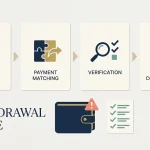
Payment speed has at least two components: the casino’s approval process and the time taken by the payment provider to deliver funds. The method matters, but so can the casino’s own processing queue and any conditions attached to the account or offer.
Published accounts of withdrawal timing do not all agree. One reported range is from 24 hours to 5 business days, depending on the payment method; another account says a payout can take three or four weeks. Treat these as differing reported outcomes, not as a promised service standard. Non-UK-regulated casinos may apply less restrictive payout policies, which can allow faster payments, but that possibility does not establish how quickly a particular withdrawal will arrive. There is no UK regulatory clock enforcing a payment deadline for a casino outside UK Gambling Commission oversight.
Withdrawal Timing
Reported payout times vary significantly, ranging from 24 hours to several weeks, as there is no UK regulatory deadline for offshore casinos.
A specialist review has also reported that some operators set daily, weekly or monthly withdrawal ceilings. Under such a rule, a large balance may have to be paid in instalments rather than in one transaction. This is not a universal condition: check the casino’s own withdrawal terms for the applicable cap, how it is calculated and whether it changes by payment method or account status. A limit can affect the time needed to receive the full balance even if each individual instalment is processed promptly.
How a bonus changes the balance
A welcome offer is not simply extra cash available for immediate withdrawal. Its wagering requirement specifies how much qualifying play must take place before bonus-related funds or winnings become withdrawable. The precise calculation matters: it may be based on the bonus alone, the deposit and bonus together, or a combination of bonus and free spins.
A specialist review has reported offshore welcome offers with wagering requirements of 35 times or more. A separate reported offer uses a 40-times requirement, but applies it to different possible bases: the bonus, the combined deposit and bonus, or the bonus together with free spins. These figures describe reported terms, not a standard that applies to every casino or promotion. Read the individual offer before accepting it, and identify which balance is multiplied and which games count towards completion.
For instance, a requirement calculated on the deposit-plus-bonus balance produces a different target from one calculated on the bonus alone. The number in the promotion is not enough to compare offers unless you know the base amount and the eligible contribution of each game. A game that contributes only partly, or does not count, can change how much qualifying play is needed.
Also look for the offer’s expiry, maximum bet while wagering, excluded games and any cap on winnings that can be withdrawn. These conditions can determine whether a bonus has practical value. If you accept an offer, the operator may apply its promotional rules to the account; withdrawing early can also cancel bonus funds or associated winnings under the stated terms.
For casino sites not registered in the UK, the useful comparison is therefore not just which payment methods appear or how large a bonus looks. Check the full route from deposit to withdrawal: available cash-out methods, processing estimates, any payout ceiling, and the exact bonus calculation. Keep the terms that applied when you opted in, since the balance you see in the account may include funds that remain subject to conditions.
What to Check Before Trusting an Offshore Casino
A polished website, a mobile-friendly design or a live casino lobby does not tell you how a dispute will be handled after you deposit. For a non-UK-regulated casino, the practical question is what happens when the operator asks for more information, changes how it treats a withdrawal or fails to return funds. Check the terms and the operator’s stated procedures before creating an account, rather than treating the site’s appearance as evidence of protection.
Before Creating Account
- Review account verification and document requirements
- Read the complaint and account-closure terms
- Identify available responsible-gambling tools
- Check the internal dispute-resolution route
Read the rules that affect access to your money
Look for the casino’s account verification, withdrawal, complaint and account-closure terms. They should explain what documents may be requested, how a decision can be challenged and what happens if the operator suspends an account. If these rules are difficult to find, vague or inconsistent across pages, you may have little clarity about what the operator can require after you have deposited.
Verification is not necessarily completed when you open an account. An operator may request further evidence before releasing a withdrawal, and the requested material can be more demanding than you expect. A specialist review has reported cases in which operators asked for notarised documents or a video call as part of withdrawal checks. Treat that as a reported possibility, not a standard procedure across non-UK-regulated casinos. Before depositing, check whether the terms explain when enhanced checks can occur and what the operator accepts as evidence.
A request for documents can also involve personal information. Consider what you would have to share, how the site says it handles that information, and whether you can understand the privacy terms. Non-UK-regulated casinos may be subject to less stringent data-protection rules than UKGC-licensed operators. That can affect the protections available to you if you are concerned about how identity or financial information is stored or used.
Check which protections actually apply
Do not assume that a casino offers the same responsible-gambling safeguards as a UKGC-licensed site. Non-UK-regulated casinos may have less stringent responsible-gambling requirements, and players may not have access to mandatory tools such as deposit limits or self-exclusion schemes. If you rely on a specific control to keep gambling within limits, establish whether that control is available on the individual site and how it works. A general claim that a casino supports responsible gambling does not tell you which tools you can set, change or enforce.
The route for dealing with a complaint also matters. If a disagreement arises, you cannot use the UK Gambling Commission’s complaints procedure for a casino it does not regulate, and you do not have access to the UK’s Financial Ombudsman Service for that gambling dispute. Some licensing frameworks also lack an independent dispute-resolution route comparable to the services approved for UKGC-regulated operators. This means that an internal complaint process may be the main route available, rather than an independent body able to review the case.
Check the operator’s own complaint instructions: where to submit a complaint, what information to include and how the casino says it will respond. Do not treat a promise to investigate as equivalent to independent review. If the terms do not describe a clear escalation route, you should account for that uncertainty before committing money.
Understand the risk to player funds
A displayed balance is a claim against the operator; it does not, by itself, show that the money is held separately from the company’s other funds. Safeguards depend on the operator and the rules of its licensing jurisdiction. For casinos with an Anjouan licence, player funds are not guaranteed to be segregated. If the operator fails, players may be unsecured creditors, meaning their claims are not backed by a promise that their balances were ring-fenced.
Fund Protection
Attention: For casinos with an Anjouan licence, player funds are not guaranteed to be segregated, meaning you may be an unsecured creditor if the operator fails.
That distinction is important because the apparent availability of a balance while an account is active does not establish what would happen if the business became unable to pay. Read any statements about fund protection carefully and identify whether they describe a binding arrangement or merely the operator’s own policy. Do not infer protection from a licence logo or from the fact that the site continues to accept customers.
Before signing up, make a short check of the casino’s terms, privacy information, complaint process and responsible-gambling controls. If a key condition is absent or unclear, you cannot safely assume that a UK-style safeguard will fill the gap. The point is not to label every non-UK-regulated casino unsafe; it is to identify which protections you would depend on and what recourse remains if the operator does not meet your expectations.
Gamban and Casinos Outside UK Self-Exclusion
Gamban and GamStop are separate services, so their coverage should not be treated as interchangeable. A casino outside GamStop is not part of the UK Gambling Commission’s self-exclusion scheme. That fact does not, by itself, tell you whether a particular site can be accessed through Gamban or how the service treats it.
If you are looking for UK casinos that are not covered by Gamban, distinguish the service’s site coverage from a casino’s self-exclusion status. A casino may be outside GamStop because it does not participate in that UK scheme; this is not evidence that Gamban will block it, or that it will remain accessible. Coverage can depend on the blocking service and the site, so do not rely on a general label as a guarantee about an individual domain.
The practical difference matters if you are using a tool to prevent access. GamStop exclusion applies within the participating UK gambling system. It does not enrol non-UK-regulated casinos or make them follow the scheme’s exclusion controls. A separate blocking service may form part of a broader plan, but it should not be treated as a substitute for exclusion at a casino or as proof that every route to gambling is blocked.
There is also a wider protection gap. Non-UK-regulated casinos may have less stringent responsible-gambling and data-protection rules than UKGC-licensed operators. You may therefore have fewer built-in safeguards, including controls designed to limit gambling or support self-exclusion. Do not assume that a site offers protections equivalent to those in the UK system simply because a blocking tool is available on your device.
If you have excluded yourself because gambling is causing harm, the safest approach is not to test whether a particular casino is reachable. Keep the exclusion in place, avoid opening accounts with sites outside it, and seek support from a gambling support service if you need help maintaining that boundary.
How a UKGC-Licensed Casino Differs
A casino’s registered office does not determine whether it is licensed to serve customers in Great Britain. The relevant point is whether the operator holds a licence from the UK Gambling Commission for the gambling it offers. An operator based abroad still needs that licence if it serves the Great Britain market; a UK address by itself does not establish that the site is authorised.
This makes “UK registered casino” an imprecise description. It can refer to where a company is incorporated or registered, but that is separate from its permission to provide gambling services. To identify a UKGC-licensed casino, look for the operator’s regulatory status, not just a UK address, a familiar-looking website or a claim that it accepts British customers.
The distinction affects which regulator oversees the operator. A UKGC-licensed casino falls within the Commission’s licensing system for Great Britain. A casino without that licence does not come under UKGC oversight, even if it is accessible from the same device or offers similar games. The two sites may look alike, but their regulatory status is different.
For you, the practical comparison is therefore not “UK company versus foreign company”. It is “licensed to serve Great Britain versus not licensed to serve Great Britain”. An operator’s location can be outside the country while its licence is issued by the UKGC; conversely, a UK-registered business is not automatically licensed to provide online gambling.
When checking a site, separate its corporate identity from its gambling authorisation. The company name and place of registration describe the business; the UKGC licence indicates whether the operator is authorised under the Great Britain system. Do not treat a foreign licence, a company registration or the ability to open an account as a substitute for that authorisation. A UKGC licence is the relevant marker for a casino serving customers in Great Britain, regardless of where its operator is based.
What Anjouan Licensing Does—and Does Not—Verify
An Anjouan casino licence identifies a regulatory framework, but it does not establish that the casino has undergone the checks a player might associate with a strong gambling regulator. In particular, Anjouan’s framework does not require independent testing of random number generators, routine audits or the separation of player balances from the operator’s own funds. The licence alone therefore cannot confirm that game outcomes have been independently tested or that money deposited by players is held separately.
That distinction matters when you are assessing whether a casino outside GamStop is trustworthy. A licence is not a guarantee of fair games, financial resilience or a particular standard of day-to-day operation. It tells you which framework the operator claims to follow; it does not, by itself, verify each of those protections.
The complaint process also has limits. An operator must respond to a complaint within 30 calendar days under Anjouan’s framework, but that response requirement does not mean the regulator will decide the dispute. The Anjouan authority does not handle, mediate or adjudicate complaints from players. If you and the operator disagree about a balance, a game outcome or the interpretation of a term, the authority is not a player-facing adjudicator.
Anjouan Licensing
- Does not require independent testing of random number generators
- Does not mandate the separation of player balances
- Requires a response to complaints within 30 days
- Does not provide an independent adjudicator for disputes
Nor do Anjouan-licensed casinos provide an independent dispute resolution route comparable to the services approved for UKGC-licensed operators. That leaves an important difference between receiving a reply from the casino and having an independent body assess the case. A response deadline is not the same as a binding decision or a route to appeal one.
When reading a casino’s claims, separate what the licence establishes from what the operator says about its own controls. Claims about game testing, audits or fund protection need their own evidence; they should not be inferred from the Anjouan licence. This is especially relevant if you are looking for trusted casinos not registered with GamStop: the absence of UKGC oversight makes it more important to understand precisely what the stated licence does, and does not, require.
What a Malta Casino Licence Tells You
A Malta casino licence places the operator within a licensing jurisdiction used by some non-UK-regulated casinos. Malta is one of several jurisdictions associated with this market, alongside Curaçao, Gibraltar and Anjouan. The licence therefore identifies a regulatory connection; it does not, by itself, establish where the operator is based.
“Malta-registered” and “licensed in Malta” are not interchangeable descriptions. Registration refers to a company’s formal status, while a gambling licence concerns permission to offer gambling under a jurisdiction’s rules. If a site describes itself as Malta-licensed, the claim should be understood as a statement about its licensing jurisdiction, not as proof of a UK licence.
For you as a player, the distinction matters because a Malta licence alone does not show that a casino is overseen by the UK Gambling Commission. Nor does the label, without further information, prove that the operator is safe or suitable for customers in the UK. It does not establish the site’s specific terms, how it handles complaints, or what protections apply to your account.
Treat the jurisdiction as one part of the operator’s regulatory identity, rather than as a general quality rating. The name of a licensing location cannot answer every practical question about a particular casino. Before relying on the label, distinguish the company’s registered location from the authority responsible for its gambling licence, and avoid assuming that a licence from one jurisdiction carries the same meaning as a licence from another.
Curaçao Casinos Outside GamStop: What the Licence Context Establishes
A Curaçao licence and GamStop status describe different things. The licence refers to the jurisdiction associated with a casino’s authorisation; GamStop is the UK Gambling Commission’s self-exclusion scheme. Knowing one does not, by itself, tell you the other.
Curaçao is among the jurisdictions that may license non-UK-regulated casinos, alongside Malta, Gibraltar and Anjouan. That makes Curaçao relevant when you are identifying where a casino’s licence comes from. It does not establish that every casino licensed there is outside GamStop. The licence jurisdiction alone is not evidence of a particular site’s registration status with the scheme.
If a casino is not on GamStop, it is not part of the scheme. But you should not infer that status solely from a Curaçao connection. A site’s location, the jurisdiction named on its licence, and its relationship to a self-exclusion service are separate details. Treating them as interchangeable can lead you to assume a restriction applies—or does not apply—without checking the relevant information.
For a particular casino, establish what its licensing information says and whether it is actually included in GamStop. The phrase “Curaçao casino” answers only a jurisdiction question; it does not settle whether the site is registered with the self-exclusion scheme. Likewise, “outside GamStop” describes scheme status, not the location or licensing jurisdiction of the operator.
This distinction matters if you are relying on GamStop to prevent access. Do not use a casino’s Curaçao connection as a substitute for confirming its status with the scheme. A jurisdiction label can help identify the licensing context, but it cannot prove that the site is, or is not, covered by GamStop.
Are Anjouan casinos connected to the GamStop self-exclusion scheme?
No. Anjouan-licensed casinos are not required to integrate with GAMSTOP, so you should not assume that self-exclusion through the scheme will block access to them.
Can UK players legally play at casinos licensed in Anjouan?
Yes, UK law does not explicitly prohibit you from using gambling services licensed abroad, and playing on an unlicensed site is not itself a criminal offence. However, an Anjouan licence does not authorise an operator to serve customers in the UK; operators serving Great Britain need a UK Gambling Commission licence.
What happens if I have a dispute with an Anjouan-licensed casino as a UK player?
You can complain to the operator, which must respond within 30 calendar days, but the Anjouan authority does not handle or adjudicate player complaints. You also do not have an independent dispute resolution route comparable to UKGC-approved ADR.
What Are Non UK Regulated Casinos?
They are online gambling sites that operate without oversight from the UK Gambling Commission. Some hold licences from other jurisdictions, such as Malta, Curaçao, Gibraltar or Anjouan, but those licences are not UKGC licences.
Casino Sites

£1 Minimum Deposit Casinos in the UK: How They Work
A £1 cashier minimum may depend on the payment method, and does not automatically qualify...

£10 Minimum Deposit Casinos in the UK: How It Works
A cashier minimum sets the smallest accepted payment; it is not a guide to how...

£2 Minimum Deposit Casinos in the UK: What to Check
A low account deposit may not meet the separate rules for a payment method, promotion,...

£20 Minimum Deposit Casinos in the UK: How They Work
A cashier minimum applies to the funding transaction, while game stakes follow the rules and...

£3 Minimum Deposit Casinos in the UK: What to Check
A cashier threshold can vary by payment method and does not determine bonus eligibility, withdrawal...

£4 Minimum Deposit Casinos in the UK: What to Check
A cashier minimum is only an entry condition; payment methods, account rules and promotion terms...

£5 Minimum Deposit Casinos in the UK: How They Work
See how the cashier minimum works and how it relates to payment methods, bonuses and...

Anjouan casino licence: what it means in the UK
Anjouan licensing sets the operator’s regulatory basis, but does not itself authorise gambling services for...

Best casino app UK: how mobile play works
See how casino apps differ from browser play, and what to check about payments, bonus...

Foreign Casinos for UK Players: Licensing and Risks
The guide explains how foreign casinos relate to UK rules and what licensing, payment terms...

International Casinos for UK Players: Key Checks
An overview of licensing, player protections, bonuses, payments and the legal considerations that distinguish international...

Pay by Phone Credit at UK Mobile Casinos
Phone-credit deposits use a mobile account to fund a casino balance, while payment availability, fees...

Offshore casino sites for UK players: rules and risks
This guide explains licensing limits, listing caveats, payment and withdrawal risks, and how offshore sites...

Offshore casinos for UK players: rules and risks
Explains how offshore operators sit outside UKGC regulation and what that can mean for access,...

British casinos not on GamStop in 2026: key facts
GamStop applies to UKGC-licensed operators, while offshore licensing and site terms require separate checks. How...

Casino No ID Verification UK: How Checks Work
A lack of document requests at sign-up does not mean an account is verified or...

Casino Sites Not Registered with GamStop in the UK
GamStop applies to UKGC-licensed operators; overseas licensing, voluntary safeguards and casino terms can differ. What...

Casinos Without a UK Licence: Rules and Risks
An overseas operator’s location does not determine whether it needs a UKGC licence to offer...

Casinos That Bypass GamStop: How It Works
GamStop applies to participating UKGC-licensed operators; a site outside the service may operate under a...

Curaçao Casino Licence UK: What Players Should Know
A Curaçao licence identifies a licensing jurisdiction, but does not establish that a casino is...

Gibraltar Casino Licence in the UK: What to Check
A Gibraltar connection or favourable ranking does not establish which authority oversees a casino or...

Merkur Casino Online UK: Games, Demos and Checks
A practical guide to spin mechanics, demo sessions, site checks, bonus terms and the limits...

Trustworthy Online Casinos in the UK: What to Check
A practical framework for checking licensing, player safeguards, verification, games and payments before opening an...

No Account Casinos in the UK: How They Work
The label describes a sign-up or payment journey, but does not explain how a casino...

No-ID Verification Withdrawals at UK Casinos
The guide distinguishes document-free sign-up claims from later checks, and explains how verification can shape...

No Minimum Deposit Casinos in the UK: What £1 Means
A low cashier minimum does not guarantee a bonus or determine how much you can...

Non-Gamban Casinos in the UK: What the Label Means
A site's accessibility on one device does not verify its licence, safety or general relationship...

Non-GamStop Curacao Casino Sites: UK Guide
A practical framework for checking licensing claims, payment methods and self-exclusion coverage without treating them...

Non-GamStop European Casinos: UK Exclusion Explained
GamStop covers participating online gambling businesses, while individual casino closures and sites outside the scheme...

Non-UK Licence Casinos: What the Licence Means
Licences from Malta and other jurisdictions apply under their own regulators and are not the...

Non-UK-Regulated Casinos: UK Rules and Risks
UKGC status depends on the operator and the market it serves, not merely on whether...

Non-UKGC-Licensed Casinos: Rules and Risks
A guide to licensing, player protections, self-exclusion and payments when a casino operates outside UKGC...

Malta-Licensed Online Casinos and UK Gambling Rules
A Malta licence covers an operator’s Maltese authorisation, while serving customers in Great Britain requires...

Online Casino No Registration UK: How Checks Work
The label may describe a shorter sign-up, but it does not remove the requirement to...

Online Casinos Without Sister Sites in the UK
Sister-site connections can involve shared ownership or technology, and do not necessarily mean that brands...

Online Slots Not on GamStop: What the Label Means
GamStop applies to participating gambling establishments, not individual games, so labels and site claims need...

Safe Online Casino UK: Licence, Checks and Risks
A UKGC licence establishes a legal baseline, while identity checks, payments, game rules and safer-play...

UK Online Casino Payouts: RTP and House Edge
RTP, house edge and game-specific figures describe long-run returns, not a guaranteed result from any...

Trusted Casinos Not on GamStop UK: What to Check
Understand the limits of trust claims and examine licensing, player protections, bonus conditions and withdrawal...

Trusted UK casinos: checking licences and safeguards
A practical look at UK licensing, public-register checks, enforcement history and the protections available across...

USA Casinos for UK Players: What to Check
A US connection or an accessible website does not establish that an operator is authorised...

VPN-Friendly Casinos in the UK: Rules and Access
A VPN-friendly label describes an operator’s approach to VPN connections, not a guarantee of access...